SARS-CoV-2: Unveiling the COVID Leviathan (2021)
by Peter Jorgensen (pen name Sofie Ostvedt)
First published in September 2021, this is a free online version of the book, 'SARS-CoV-2: Unveiling the COVID-19 Leviathan', written by Peter Jorgensen, and published under the pen name of Sofie Ostvedt. ISBN: 9798467050706. The book contains no images, these have been added to help illustrate the online version.
Contents
Preface // Chapter 1 // Chapter 2 // Chapter 3 // Chapter 4 // Chapter 5 // Chapter 6 // Chapter 7 // Chapter 8 // References
Everything that you're being told is either adjacent to the truth, or an exaggeration, it’s not correct.
Dr Mike Yeadon - former VP of Pfizer, Canterbury Freedom Rally, 15th May 2021.
3. Testing
The declaration of the COVID-19 pandemic was directly connected to testing regimes that were implemented internationally, mostly following the guidance of the WHO. The predominant test used, particularly in the early stages of the pandemic, was the RT qPCR test (reverse transcription quantitative polymerase chain reaction). This test uses methods that find fragments of viral RNA and then artificially replicates the number of these fragments in repeated cycles until there are sufficient for the test to confirm detection. The WHO issued guidelines for performing tests based on a scientific publication from January 2020 (referred to as the Corman-Drosten paper); it had suggested a protocol for identifying cases of COVID-19 via PCR test [46]. PCR testing was soon rolled out across the globe. However, serious concerns were identified with the Corman-Drosten paper. In December 2020, an independent group of scientists published a formal request for the paper to be withdrawn [47]. Their concerns included that: the paper was published within a day of having been submitted, suggesting that a proper peer review process had not taken place; the paper was published in a journal of which two of its authors were also members of the editorial board; the proposed test suggested identification of only two genes rather than three - the latter being standard in use of PCR to aid diagnosis of viral disease; the methods recommended a notably high concentration of primer which could lead to a high false positive rate; the researchers developed their protocol using a computer-modelled viral genome without testing for reliability and accuracy against a real viral sample verified at molecular level; no cycle threshold was proposed, but it appears the authors used 45 - an extremely high and unreliable number unsuited to the use of PCR as a diagnostic aid. A more detailed discussion of cycle thresholds will follow later in this chapter.
Even disregarding the many issues specific to the Corman-Drosten paper, the PCR test is not reliable for disease diagnosis as a standalone measure because it only detects viral fragments and not the whole virus. This means that a positive test alone cannot determine whether a person is, or has been, infected, nor whether they are infectious to others. For reliable diagnoses, there must be an accompanying clinical diagnosis of symptoms, exclusion of other causal factors, and preferably additional supportive tests such as full gene sequencing, antibody tests etc. The need for clinical information to be used in diagnosis was explicitly stated by Public Health England [48]:
A single Ct value in the absence of clinical context cannot be relied upon for decision making about a person’s infectivity.
And the World Health Organisation [49]:
Most PCR assays are indicated as an aid for diagnosis, therefore, health care providers must consider any result in combination with timing of sampling, specimen type, assay specifics, clinical observations, patient history, confirmed status of any contacts, and epidemiological information.
Despite this, across the globe, cases of COVID-19 were being based on a single positive PCR test [50]. This was distinctly unusual - none of the testing regimes for SARS-CoV-1, Zika virus, Ebola, H1N1 influenza, and MERS-CoV abandoned the need for additional considerations to support a positive test before a 'case' was confirmed [50]. Ideally, for definite confirmation of disease-causing infection, a viral culture taken from a symptomatic person is the only truly reliable test. This was pointed out in a letter published in March 2020 in the New England Medical Journal. The author discussed concerns about patients who appeared to test positive long after remission of any symptomatic disease and went on to highlight the fact that a PCR test alone was not adequate for proof of infectivity [51]:
...the viability of 2019-nCoV detected on qRT-PCR in this patient remains to be proved by means of viral culture.
The distinction between whether a person is infectious or not is extremely important. Generally, if a person is shedding particles of virus that pose more than a very remote risk of infecting others (i.e., large numbers of whole and viable virus as opposed to broken down 'dead' viral pieces) they will be symptomatic - typically any combination of the following: runny nose, cough, sneezing, or sweating. It may be possible to find examples of transmission just prior to the onset of symptoms - what the CDC had referred to as pre-symptomatic, but this is different to asymptomatic where no symptoms are experienced at any time [52]. Unfortunately, this important difference has largely been misrepresented by scientific authors, key broadcasters, media channels, and the CDC itself who have misinformed the public about the lack of evidence showing any significant risk of spread from people who never develop symptoms. A study based on a sample population of 10 million people in China confirmed this - the authors stated [53]:
The detection rate of asymptomatic positive cases was very low, and there was no evidence of transmission from asymptomatic positive persons to traced close contacts [emphasis added].
Any protocol for using PCR to help with disease diagnosis will use a cycle threshold. That is, the number of times a sample can be amplified before a test becomes unreliable; it is at, or before, this threshold that a test will be declared positive or negative. Research has shown that it becomes impossible to culture live virus from samples which test positive at cycle thresholds above 33; the most reliable results coming from use of cycle thresholds of 17 or less [54]. The levels of reliability can vary according to factors that may differ between laboratories during the implementation of their tests. Such variables include the nature of reagents used, the type and length of RNA sequences being detected, and the number of genes being tested for. However, there are two key points to note about PCR tests in general. Firstly, the more cycles required to find a positive result, the less reliable they are. Secondly, they cannot, and should not, be used in isolation of clinical symptoms to diagnose disease. Where symptoms are present, clinical investigations should be carried out to exclude other possible causes for those symptoms. This is hugely important when contemplating whether there is justification for severe containment measures that deprive people of their basic human rights. The conclusion of a review published in the journal 'Clinical Infectious Diseases', stated [55]:
A binary Yes/No approach to the interpretation [of] RT-PCR unvalidated against viral culture will result in false positives with possible segregation of large numbers of people who are no longer infectious and hence not a threat to public health.
In late spring of 2021, the Swedish Public Health Agency (SPHA) concluded that PCR tests were not suitable for determining whether somebody is contagious or not [56]. It is unclear what took them so long, or why others didn't follow suit. The reason the SPHA gave for their decision was that PCR could detect residual viral particles weeks and possibly months after infection and at a time when people were clearly not presenting any risk of contagion to others. In 2020, a meta-analysis of studies evaluating the accuracy of PCR test results used in viral infection detection suggested a median false positive rate of 2.3%, the most accurate testing regime produced a false positive rate of 0.3%. So, if you tested 1000 people with the highest level of accuracy you would get 3 positive results even when there is no disease in the sample population at all. If you tested 100 000 people per day for a year your cumulative number of false cases based on a single positive test would be over 10 000. At a false positive rate of 2.3% you would end the year with a cumulative total of 839 500 cases that were not cases at all. If all these people were quarantined for 14 days, there would be a total quarantine time of over 32 000 years. That is 32 millennia of loss of freedom imposed on people neither infected nor infectious.
False positive rates can be reduced by lowering the cycle threshold used in the PCR test. Alarmingly, it is very difficult to discover what cycle thresholds were being used to support the case numbers that justified draconian limits on civil liberties and travel across the globe. There was no internationally agreed standard and the WHO advised test centres to follow test-kit manufacturer's guidelines. In the UK, Professor Martin Neil discovered that two laboratories, both run by the same firm, were not following manufacturer's instructions which required that a minimum of two genes were tested for. Professor Neil had a letter published in the BMJ which stated [57]:
...the UK lighthouse laboratories appear not to be in strict conformance with the WHO emergency use assessment and the manufacturer instructions for use. Given this it is clear the ONS and the UK lighthouse laboratories needs to publicly clarify their use of, and justify the reasons for, deviating from these standards.
In the UK, a freedom of information request was submitted to the ONS in an attempt to discover data on cycle thresholds but it was rejected. The reason the ONS gave was highly dubious - that statistics on cycle thresholds could be used to identify test subjects and as such the data was considered non-disclosable personal data [58]. Surely a dataset could have been provided that contained laboratory information, cycle thresholds and corresponding decisions on positive or negative results without any personally identifiable data being included? In August of 2020, the New York Times reported that most cycle thresholds in the US were being set at 40, noting that this would produce a case detection rate tenfold higher than if cycle thresholds were set at a more reliable figure of 30 [59].
In the USA, the CDC encouraged submission of samples that had tested positive for SARS-CoV-2 so that they could be genetically sequenced. However, their guidance required that only samples that tested positive at cycle thresholds of 28 or lower should be submitted [60]. The reason being - it is virtually impossible to sequence whole virus from samples which tested positive at higher cycle thresholds because they would have no viable virus present. An article in the 'Journal of Infection' analysed a broad sample of PCR test data and found that increasing the cycle threshold from a maximum of 24 to a maximum of 29 generally produced a 50-100% increase in positive test results [61]. The authors noted that an approximately corresponding proportion of positive test subjects (45-68%) in the UK reported that they were symptom free. The authors concluded:
In light of our findings that more than half of individuals with positive PCR test results are unlikely to have been infectious, RT-PCR test positivity should not be taken as an accurate measure of infectious SARS-CoV-2 incidence.
This is a crucial point. If the test cannot be considered accurate it should not be used to frighten people, remove their rights and freedoms, deprive them of contact with friends and family, or leave them out of pocket. Yet official guidance did not seem to treat the fundamental rights of the citizenry with respect. For example, Public Health England did not recommend any threshold but suggested a maximum of 40 was standard practice - as such this may well have been a figure that laboratories adopted [48]. In January 2021, as vaccine programs were rolled out globally, the WHO issued a notice of guidance seemingly as a stern reminder that laboratories administering PCR tests should be wary of using high cycle thresholds to produce positive cases and reminded them to pay close attention to the 'instructions for use' when performing such tests [49]. It is not clear what prompted this notice to be issued at this time, but it is not unreasonable to suggest that the organisation had become aware that laboratories were not following best practice guidelines (as per Lighthouse laboratories in the UK mentioned previously). Neither is it clear whether issuance of this notice had any influence on testing regimes and reported case numbers in the weeks and months that followed.
It would be extremely important to know if laboratories tightened standards for testing, and when, as this could have significantly reduced case numbers and positively influenced assessment of the efficacy of vaccine programs. Attempts to locate large data sets showing the PCR cycle thresholds used by laboratories, regions, or nations over the course of the pandemic has not yielded results. Yet, such data would be essential for use in analysis of how testing regimes were affecting 'case' counts for COVID-19, and whether techniques between nations and regions were different or had changed over time.
In epidemiology, a 'case' is supposed to be a person who is confirmed as suffering from a disease or condition. Counting cases requires a list of specific criterion which must be met. Globally, for COVID-19, there was no standard definition of a case. It appears many countries have counted cases as positive tests ignoring the need for additional criterion to be met, i.e., clinical diagnosis. For a person to be diagnosed as a 'case', and hence at some point infectious, they would require the minimum of a positive test (at a cycle threshold of 33 or preferably much lower) and, at the very least, they should be found positive for distinctive clinical signs upon medical examination. Yet no such scientific rigour appears to have been applied. Indeed, different countries were using divergent, and often equally spurious, measures for defining a case. For example, in the UK, a person could be tested three times, found negative on two of those occasions, be completely clear of any clinical symptoms and yet still be counted as a 'case'; in France any untested person with a symptom similar to the flu or a common cold could potentially qualify as a 'case' even in the absence of a test [62].
Another highly problematic situation is the impact of false positive results in areas of low prevalence of infection. In these circumstances, the significance of the false results could have a huge impact. Researchers have investigated this issue. One study sampled a population of over 5000 and found just 31 positive tests [63]. The tests were deliberately performed using cycle thresholds of 35 or above - noted to be of low reliability. The samples producing positive tests were then subject to further scrutiny. Of the 31 samples that had tested positive, 26 were found to have tested positive for only one gene, 3 were positive for two genes, and 2 were positive for three genes. Additionally, only 12 out of the 26 people who had tested positive for any gene showed any symptoms. Most of the 12 symptomatic participants did not have their symptoms attributed to COVID-19 by the researchers because they failed to test positive for more than one gene. The researchers argued that if the presence of multiple genes is not detected then this is evidence that there is a lack of complete and viable virus present. They concluded that only 16% of the positive tests could be reliably counted as positive indicators of infection. The remaining 84% being false. The authors of this research expressed serious concern about the many detrimental effects that could arise as the result of policies based on a great number of false positive cases. Such detrimental effects included: delayed or cancelled treatment for patients, some of whom were suffering from cancer or in need of organ transplants; short staffing caused by policies which require non-infectious asymptomatic staff to isolate at home; patients due for discharge being held in hospital unnecessarily; and additional costs from activity arising from retesting and track and trace policies. The science proving that PCR testing was unreliable was central to a legal case brought in Portugal. There, senior judges supported the decision of a lower court who had ruled that the results of a PCR test alone cannot stand as justification for enforcing the quarantine of foreign nationals and such action was in violation of both domestic and international law [64]. The case was not reported by any major media outlets.
Contentious issues with PCR testing were not limited to cycle thresholds and its misuse as a diagnostic. For example, in the USA, a scandal emerged over contamination. When the initial CDC testing regime was rolled out in March of 2020, only testing kits authorised and issued by the CDC itself were permitted for use. However, after just two weeks of use these tests were flagged as being extremely unreliable. The problem was only discovered after 24 public health test centres conducted trial tests on unused kits and found that they produced positive results [65]. A brief investigation concluded that due to rushed production the kits had probably become contaminated by exposure to reagent material and the CDC had failed to adhere to standard quality control measures which should have been in place to detect such an issue. It is not clear what reagent was said to have caused the contamination, nor exactly how it came into contact with so many test kit components.

Problems also occurred on the opposite side of the Atlantic. In the summer of 2020, the UK government recalled 750 000 tests due to undisclosed safety concerns [66]. Later that year, undercover filming revealed poor practice in testing laboratories which would undoubtedly have caused contamination and false positive test results [67]. One of the most shocking incidents reported in the UK occurred when Birmingham council was found to have been handing out tests that other people had already used. This occurred during a doorstep campaign that pressured people to complete their tests ready for collection 15 minutes later [68]. This mistake was only discovered when a student noticed the swab they had been given had clear signs of prior use and raised the alarm.
Unreliability in testing regimes may also be connected with the outside possibility that sections of corona virus are being reverse transcribed into human chromosomes. To date, there is no evidence that this has definitely occurred (is anyone looking?) but laboratory research has provided evidence that it is feasible [69]; one of the potential implications for affected people is that they may test positive for the virus for a long time after an initial infection. A type of enzyme called reverse transcriptase is involved in the process of taking RNA and inserting it into DNA. Human cells produce reverse transcriptase endogenously and it is understood to play a crucial role in the maintenance of chromosomes (structurally organised DNA) [70]. Similarities have been drawn between this mechanism and the way in which retroviruses such as HIV and hepatitis B operate. However, retroviruses typically carry their own reverse transcriptase to facilitate the insertion of their RNA into our DNA. It is notable that there have been reports of people testing positive over prolonged periods of time. One example comes from Italy where a case report documented an incidence of a recovered patient who tested positive more than two months after full recovery from a corona virus infection [71]; there was no evidence of reinfection or clinical disease. The case could be explained by reliance on PCR testing regimes that use cycle thresholds of 45, in accordance with WHO guidance, and consequently detect viral fragments and not in-tact viable, infectious, virus [72].
A thorough review of testing protocols and standards, written by Dr Sin Hang Lee of Milford Molecular Diagnostics Laboratory, also noted another serious issue with testing guidance issued in the USA. The CDC had published testing protocols that only recommended detection of 25 contiguous base pairs of DNA falling remarkably short of the 100 continuous base pairs recommended by the FDA for the detection of viral disease infections [73]. (Note: the SARS-CoV-2 virus is an RNA virus and as such has no paired bases but DNA with base pairs is created from the RNA as part of the PCR testing technique.) The crux of Dr Lee's analysis was to highlight how problematic unreliable testing protocols could be. Of concern was the fact that a false positive test could condemn a person, possibly an uninfected hospital patient or care home resident, to prolonged containment in quarantine facilities, or on isolated hospital wards, with genuinely infected patients. This would lead to a high risk of exposure to the virus in persons who were potentially vulnerable to the most severe effects of infection yet who otherwise were not (yet) infected themselves.
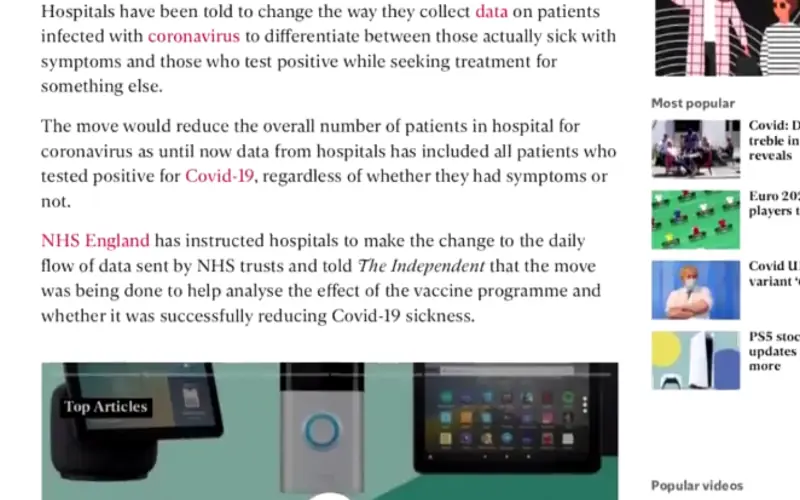
Despite the liberal use of high cycle thresholds, the requirement for unusually low numbers of DNA base-pairs, and no requirement for clinical diagnosis in the counting of cases during 2020 and early 2021, this changed once vaccines were rolled out. In the UK, the NHS instructed hospitals to only count people who were sick and symptomatic for COVID-19 as corona virus related admissions, previously they had counted anybody with a positive test [74]. The reason given was to improve accuracy in reporting the success of vaccines. Clearly the change in policy alone would result in a massive reduction of COVID-19 related hospital admissions being reported even if vaccines were entirely inconsequential; the press were silent about the matter. In July of 2021, a story emerged that suggested around 40% of people who were being counted as COVID-19 hospital admissions had actually been admitted to hospital for other causes, they were not sick with COVID-19 and merely tested positive as part of routine testing regimen [75]. It is unclear whether this method of counting was being applied to all patients or only the unvaccinated.
In May 2021, in the USA, the CDC also issued new guidelines for counting vaccine breakthrough cases (breakthrough cases are incidents where people who have been vaccinated later contract the disease they were vaccinated against) [60]:
As of May 1, 2021, CDC transitioned from monitoring all reported vaccine breakthrough cases to focus on identifying and investigating only hospitalized or fatal cases due to any cause. This shift will help maximize the quality of the data collected on cases of greatest clinical and public health importance.
A shift to only identifying, and monitoring, hospitalised or fatal cases would cause a huge difference to counting post-vaccine COVID-19 cases. The vast majority of 'cases' do not result in death and do not occur in people who need to be detained in hospital for treatment. If these changes were adopted, people with non-severe symptoms and those with none (asymptomatic), would not be counted. Why the sudden shift after over a year of doing things differently? Why did these changes in policy also coincide with the change in seasons and occur at a time when increasingly significant numbers of people had been vaccinated? Other changes in approaches to testing also occurred around this time.
In April 2021, the UK government rolled out a new national testing programme based on lateral flow tests after it had quietly dropped the widely publicised £100 billion 'operation moonshot' scheme. The aim was to increase the scope of testing by moving away from reliance on PCR with faster, easier to use, and more easily accessible tests. However, concerns about accuracy were raised early on with reports that as many as 98% of positive test results could be false in areas with low disease prevalence [76]. In the USA, reliability of the tests was deemed so poor by the FDA, that they refused authorisation for their use and publicly stated that the company who developed the test, Innova, had been misleading about claims for its efficacy [77].
Having signed a contract with Innova prior to testing the efficacy of their product, the UK Government ignored the issue and continued to use the tests despite evidence that they were less than 50% accurate in real-world use. However, it is worth noting that this damning analysis of the accuracy of the lateral flow tests was carried out via comparison with PCR tests using high cycle thresholds. An article in the Lancet attempted to clarify the issue. It suggested that the lateral flow tests were not designed to detect people who were not infectious - i.e., a positive test should not result from a low or no viable viral load, something which would occur with a PCR test run at a high cycle threshold, i.e., above 28 [78]. However, the author still noted that the lateral flow tests were not very reliable. Notably, the article also expressed frustration with regard to PCR protocols in use:
There is no international standardisation between laboratories and assays, leaving Ct calibration with viral load poorly reported and easy to misunderstand.
Remember, this is the PCR test that was used as the basis for declaring a pandemic and continued to be the core justification for locking down most of the planet.
Pete Jorgensen is a singer songwriter, guitar player, bass player, sound engineer, philosopher, author, artist, and horticultural scientist who has lived in Liverpool, Lancaster, Lancashire, Cornwall, Camden, and Surrey, England, UK.