SARS-CoV-2: Unveiling the COVID Leviathan (2021)
by Peter Jorgensen (pen name Sofie Ostvedt)
First published in September 2021, this is a free online version of the book, 'SARS-CoV-2: Unveiling the COVID-19 Leviathan', written by Peter Jorgensen, and published under the pen name of Sofie Ostvedt. ISBN: 9798467050706. The book contains no images, these have been added to help illustrate the online version.
Contents
Preface // Chapter 1 // Chapter 2 // Chapter 3 // Chapter 4 // Chapter 5 // Chapter 6 // Chapter 7 // Chapter 8 // References
Collective fear stimulates herd instinct and tends to produce ferocity toward those who are not regarded as members of the herd.
From 'Unpopular Essays' by Bertrand Russell
4. Deaths
a. Cycles of Fear
SARS-CoV-2 is said to have been isolated from respiratory tract samples taken in China at the beginning of 2020; the virus was reported to have been cultured on cells taken from human lung cancer patients [79]. The gene sequences taken from the samples formed the basis for the global testing program. A testing program that was integral to determining SARS-CoV-2 (the virus) as the causative factor in most of the deaths attributed to COVID-19 (the disease). Indeed, it is data from testing and associated deaths that supplied the WHO with the statistical information it used to declare a pandemic. Initially, the WHO had declared the emergence of the disease a 'Public Health Emergency of International Concern' (PHEIC). The pandemic was officially declared on the 11th of March 2021. Pandemic is scary word. Fear drives human behaviour in a very powerful way. For many, threats of death can instil the greatest fear. As shown in chapter 3, any testing regimen dependent on PCR tests carried out with a high cycle threshold is likely to prove very unreliable as a diagnostic. Yet the case count that led to a declaration of a pandemic, and the deaths attributed to the new disease, were fully dependent on PCR testing.
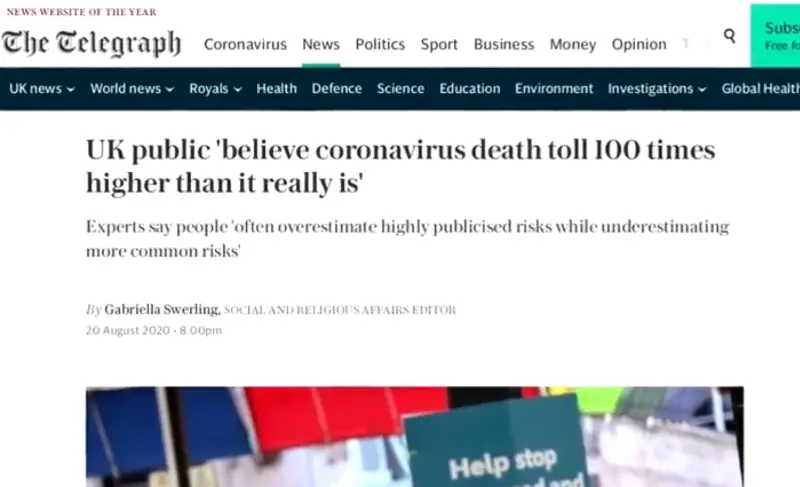
Government sponsored media fearmongering left the UK public terrorised. Many developed an extremely distorted perception of what was really happening. A poll, taken in the summer of 2020, suggested the public believed the death rate was 100 times higher than it actually was [80]. This was not just down to sensationalism but largely the result of deliberate government policy. The UK government had long made use of behavioural science and social psychology in order to control and manipulate public behaviour (a practice euphemistically known as 'nudging'). In 2010, the practice became more explicit with the formal organisation of a governmental group known as the Behavioural Insights Team; a group that later morphed into a private company partially owned by the Cabinet Office. Such a melding of private industry and the highest levels of government has significant parallels to the constructs involved in creating a top-down fascist state.
For the pandemic, a special behavioural science unit was established - the Scientific Pandemic Influenza Group on Behaviour (known as SPI-B). Their aim was to ensure that the public felt so threatened and terrorised that they would be compliant to government diktats in their behaviour. Members of the committee have since expressed their dismay at how the policy that emerged from the unit lacked ethics and was acting in a manner befitting an immoral totalitarian dictatorship [81]. Death, guilt, and vindictive social groupthink were at the core of their fear campaign. You will die or you will cause death by COVID-19 if you do not obey. You are heartless and uncaring if you do not obey. You will kill your frail elderly loved ones if you do not obey. And so on. A rapidly rising daily death count was one of their prime tools.
Malcolm Kendrick, who was working as a GP for the NHS in 2020, raised concern about the number of deaths that were being attributed to COVID-19 early on; many were being counted without any confirmatory test at all [82]. He expressed misgivings about the number of people being killed by lockdown policies rather than COVID-19 and he was also worried about the hysteria surrounding the virus; something which appeared to manifest as an implicit policy to inaccurately attribute as many deaths as possible to COVID-19. While many medical professionals were too busy, too terrorised, or too scared about their career to speak out, other lone voices such as Dr Renee Hoenderkamp, a London GP, made their concerns public too. In April 2020, an article she authored was published in Pulse - a magazine aimed at the General Practice community. In it she said:
I am massively concerned that we are blinded by the headlights and the resultant deaths will be equalled if not excelled by other causes that we are now ignoring.
She was prompted to publicise her concerns after a number of her seriously ill patients had potentially life-saving treatment cancelled.
b. Deaths and Pandemic Policy
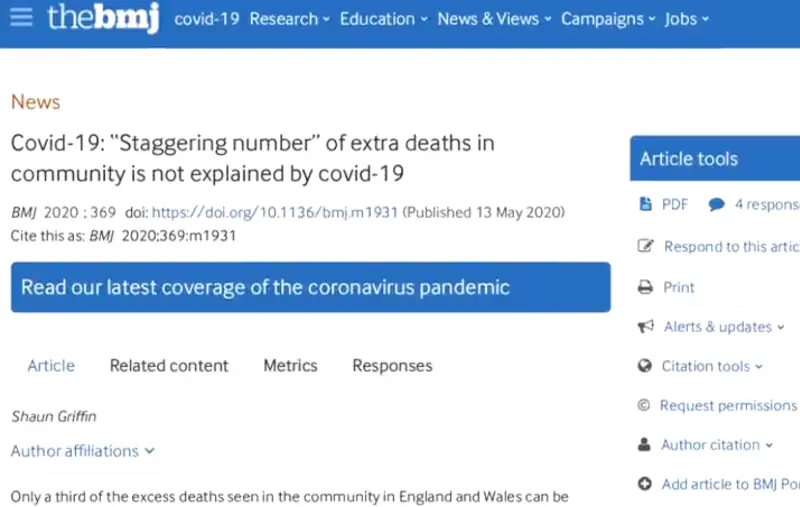
The ongoing death toll attributed to COVID-19, and deaths caused by lockdown policy, are topics that warrant further examination; especially those that occurred during the first wave in spring of 2020. What is particularly worrying is that a large number of first-wave deaths, those that appeared in the daily news in ever-increasing numbers, may not have been caused by SARS-CoV-2. In addition to concerns raised by medical professionals, a substantial number of relatives of people who died during the first wave felt strongly that their loved ones had been identified as COVID-19 deaths incorrectly and there were calls for an inquest [85]. An article published by the British Medical Journal supported their concerns. The author argued that out of 30 000 excess deaths that occurred during a five-week period in 2020, 20 000 were not attributable to COVID-19. They appeared to have been connected with lockdown policies such as the sudden removal of thousands of vulnerable patients from hospital care into community settings that were inappropriate to their needs [86]. Many of these patients were moved without first being tested. It is likely that many who were infected with COVID-19 were hurriedly placed in care settings where workers did not have access to suitable PPE and where they lacked adequate medical training. As a result of the move, large numbers of uninfected but vulnerable people would then have been exposed to, and infected by, SARS-CoV-2 [87]. Additionally, they were deprived of contact with loved ones and confined to their rooms where they had no access to fresh air and sunshine. These policies were challenged by key players in the industry who raised their concerns with government departments, including those under the direction of ministers Matt Hancock and Helen Whately. However, these concerns were ignored. In total, around 25 000 patients were moved from hospital into care homes before a mandatory testing scheme was put into place [88]. This move occurred in tandem with a blanket policy to impose 'do not resuscitate' orders on the elderly and people with learning disabilities without their consent or that of their relatives [89, 90]. Again, such a policy could only result in more deaths.
The Nuffield Trust calculated that around 40% of the 48 213 deaths that were attributed to COVID-19 during the first wave occurred in care homes [91]. It was also revealed that potentially life-saving treatment was withheld from disabled and chronically ill patients who were admitted into hospital; a fact made more disturbing by ONS figures which show that 60% of those who died following a positive corona virus test in the UK during 2020 were disabled [92]. Alarm has been raised over similar policies being deployed elsewhere in the world. For example, New York saw 9000 COVID-19 patients sent from hospitals directly into care homes [93]. Indeed, Matt Hancock defended his decision to send hospital patients into care homes on the basis that many other countries were doing the same [94]. It is not just policies concerning vulnerable patients and care homes that may have caused such a high death toll. Restrictions over the deployment of effective medicines and use of poor treatment techniques may also have contributed.
c. Ventilation
One treatment used on critically ill patients was ventilation; their inappropriate use appears to have contributed to an avoidable increase in deaths early in the pandemic. Medical professionals have suggested that the type of lung damage caused by COVID-19 made ventilation ineffective, inappropriate, and damaging - figures from New York suggest that up to four times more people may have died because of initial treatment policy that recommended mechanical ventilation too readily [95]. A treatment guide issued by the WHO in early March 2020, is one of the reasons mechanical ventilation was deployed. Mechanical ventilation was put forward as standard practice for use on patients with more severe respiratory difficulties [96]. However, there was a notable increase in survival rates once concerned doctors began to reject the use of ventilators in their treatment of COVID-19 patients [97, 98].
d. Midazolam
Another form of treatment that may have exacerbated death rates was use of a prescription sedative called Midalozam, a form of benzodiazepine. It is common practice to use it for palliative care, but expert opinion is that it should not be used in patients suffering from severe respiratory problems unless there is no chance of recovery [99]. This is because the drug relaxes muscles and makes breathing more difficult for those already struggling to respire. Use of Midazolam has also been associated with an increased risk of developing serious pneumonia [100]. In the UK during April 2020, double the number of prescriptions were issued for the drug when compared with previous years. Much of the extra volume of the drug appears to have been given to people in care homes who were suffering from more severe cases of COVID-19, or other respiratory diseases, and were already struggling for breath [101]. For any of these patients who may have had chance of recovering, the use of Midalozam could well have acted as a form of euthanasia. In July 2021, the Telegraph revealed that the placing people over the age of 70 into care homes and putting them on death pathways was part of a secret pandemic preparedness plan drawn up for the NHS in 2016; it was designed to prevent the NHS becoming overwhelmed [102]. Yes, the withdrawal of clinical care and the use of death pathways leading to a great number of fatalities was a policy designed to 'protect the NHS'.
e. Fatality rates
In March 2020, the director general of the WHO - Tedros Adhanom Ghebreyesus - declared that the global COVID-19 death rate was 3.4%, specifically noting that this was very serious because death rates from the flu were generally less than 1% [103]. At this point, the terms death rate, case fatality rate (CFR) and infection fatality rate (IFR) were being used with equivalence and interchangeably. It was this announcement by the WHO, alongside modelling based on this figure, that panicked many governments to consider, and then implement, draconian lockdown measures. Such measures included moving sick patients into care homes where they were without access to the professional medical care available in a hospital setting, isolated from human contact with friends and family, and deprived of fresh air and sunshine. However, the initial death rate figure used by the WHO was wrong by a considerable margin. Later analysis by Professor John P. A. Ioannidis, eventually published by the WHO in October of 2020 (five months after submission), confirmed that the infection fatality rate was more likely to be 1% or lower - similar to the flu [104]. A separate paper published by Professor Ioannidis concluded that the risk of death from COVID-19 in low-risk groups was roughly similar to that of the daily commute [105]:
People <65 years old have very small risks of COVID-19 death even in pandemic epicentres and deaths for people <65 years without underlying predisposing conditions are remarkably uncommon.
To understand the lethality of a disease it is important to be clear about some of the technical terms used (and misused) by health experts and scientists. Infection fatality rates and case fatality rates are different. Choosing one over the other can make a substantial difference to predictions and perceptions about the severity of an outbreak of infectious disease. An infection fatality rate (IFR) is used to refer to the number of people who die compared with the number estimated to have any type of infection, including those who may have gone undiagnosed having experienced only mild or unremarkable symptoms. A case fatality rate is used to refer to the number of people who die compared with those who have confirmed infections - generally those who display moderate to severe symptoms. This could become particularly confusing due to the way cases were being recorded for COVID-19, often based on unreliable tests performed on people with no symptomatic disease and a lack of clinical diagnosis. However, there is an essential point to be made. An IFR will generally have a much larger estimate of infections in a population compared to deaths and, as such, will tend to be a significantly lower ratio than a CFR. In the case of COVID-19, testimony before US congress that was intended to help inform early decision making on how to respond to COVID-19 compared the IFR of flu and the CFR of COVID-19, making out that the latter was ten times more deadly when it was not [106]. By March of 2021, the US CDC's analysis of IFR suggested it was best to consider age-banded figures. For the under 17s, the IFR was 0.002%, in the group of 18–49-year-olds it was 0.05%, between 50 and 64 years 0.6% and over 65 a much higher figure at 9% [107]. However, for many people even these figures are inaccurate estimates. As with any respiratory virus, those with other health issues are generally at far higher risk than those who are generally healthy. Professor John Ioannidis, an expert epidemiologist from Stanford University, analysed data from over 90 countries to reach a global average IFR of 0.15% [108].
Generally, high income countries with higher proportions of the population who are elderly have an IFR that is four or five times higher than low-income countries which have greater proportions of young people [109]. It is important to note that the IFR of evolving respiratory viruses can also change significantly during different years. Regardless, the initial response by the WHO and gross over-estimates of death rates may have contributed to public hysteria which is likely to have had significant psycho-social influence over medical professionals when determining cause of death.
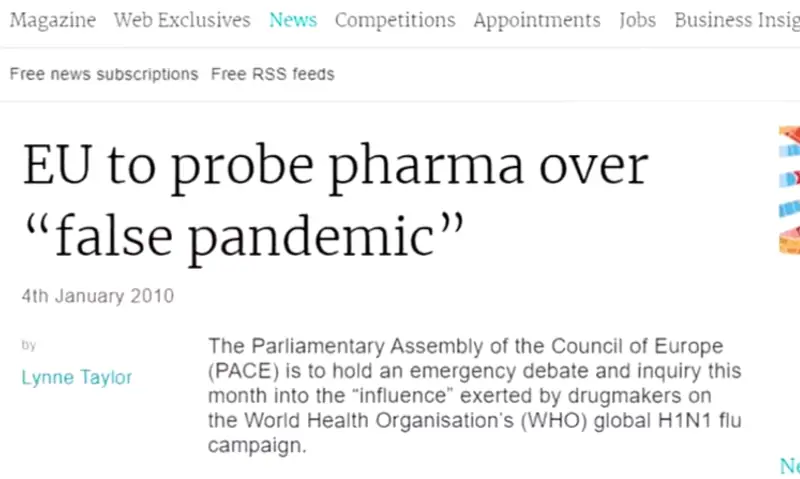
One way of analysing whether COVID-19 deaths were being over-estimated would have been to use comparative analysis with deaths that were verified via post-mortem examination. However, such evidence is largely unavailable for most countries because very few post-mortems were carried out. Nonetheless, there is some evidence of deaths being over-counted. For example, Lawmakers in Minnesota believe that up to 40% of deaths had been misattributed to COVID-19 [110]. In June 2021, the Telegraph reported that a similar proportion of deaths were being misattributed to COVID-19 by the ONS, contravening WHO guidance [111]. If suspicions about vastly overestimated death counts are correct this would make the real IFR for COVID-19 substantially lower than published figures suggest.
f. Comparing Historical Mortality
Comparing the total number of deaths to previous years can be very misleading as populations can change in size, demography, and general levels of fitness. Excess death is a problematic concept because it is defined upon the basis of expectations - often based on comparatively short periods of time. The Office for National Statistics counts excess deaths as those running above the previous 5-year average. While the figure gives an idea of how the current year compares with recent mortality trends, the use of the word excess suggests that these deaths should have been avoidable. However, life is more complicated than that. Trends in any direction are rarely anomaly free and human experience shows that there are frequently incidents that lead to jumps in death rates. The ONS could choose any number of years from which an average number of deaths could be used as a comparison with the current year. Doing so would produce a different frame within which current mortality could be understood.
Excess death is effectively an arbitrary concept, but the use of excess death statistics can result in alarmist headlines. Comparisons to the early 20th century Spanish influenza pandemic or suggestions that mortality was worse than at any time since World War II were extremely unbalanced [112]. Such stories were designed to conjure fear. A more balanced analysis might have sought to understand death rates in the context of several factors. For example, comparison could be made with other years in which there were spikes in deaths. Patterns of economic decline could be considered. The influence of changes to NHS staffing and resourcing and a changing demography - such as increases in the number of elderly people – could be accounted for.
There is little doubt that 2020 saw a substantial spike in deaths but this fact is less dramatic if we consider context, including historical mortality rates, in a more sober light. As a matter of fact, deaths per 100 000 population in England and Wales were lower in 2020 than in 2003 and every preceding year [113]. Both 2015 and 2018 saw large numbers die due to seasonal disease including influenza in England and Wales. In fact, 2018 saw a whopping 154 000 deaths occur within the three-month period of January to March and 'excess' winter deaths were higher in 2018 than any year since 1975; yet life went on as usual [114]. Similarly, if we look at the deaths that occurred in 2008, we can see that 509 000 people died – 99 000 fewer than 2020 when 608 000 died [115]. However, the total population of England and Wales in 2008 was also around 5 million people fewer. England and Wales have seen the population increase by the equivalent of the entire population of Norway within 12 years. This means there are more people who might die. Additionally, the average age of the population had also risen.
So, in 2020 there were millions more people and proportionality many more elderly within the overall population. This means that when we look at age-standardised mortality we find a less sensational picture emerges. Age-standardised mortality makes adjustments for the proportion of elderly in a population and works from the number of deaths per 100 000 population. In England and Wales, 2008 saw an age-standardised mortality rate of 1091 per 100 000 - significantly higher than 2020 when it was 1043 per 100 000 [115]. In fact, 2008 and every year prior had higher age-standardised mortality rates than 2020 [113]; still undesirable but not quite so sensational or fear-inducing as some media headlines would have people believe.
Another facet of the pandemic propaganda involved the continuous highlighting of pressures on the NHS. However, the NHS was on its knees long before COVID-19. The total number of available hospital beds in England in 2020 was less than half that of the late 1980s [116, 117]. Between 2011 and 2020 around 15% of hospital beds were lost due to cuts and changing practice - around 20 000 in total. However, approximately 8000 of these beds were lost directly due to changes in bed arrangements attributed to pandemic infection control measures implemented in 2020. Yet these 'safety' measures were only made possible by removing elderly and disabled inpatients from hospital and placing them into care homes where they were deprived of expert medical care and where many became infected with SARS-CoV-2 and subsequently died. The rushed establishment of nightingale hospitals, costing over half a billion pounds, aimed to plug this reduction in capacity by making several thousand beds available. In practice only a few hundred beds were used; several of these hospitals did not treat a single COVID-19 patient. This was largely due to an omission in planning for a core functional component that was already in short supply in the NHS - the staff [118]. It is difficult to believe that the politicians and planners involved in creating these emergency units were not aware NHS resources, especially staff, were already stretched to their limit.
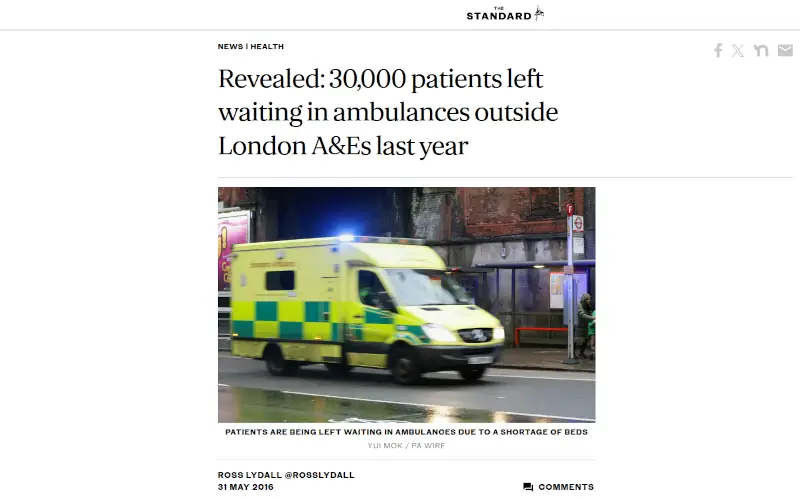
The preceding decades-long attack on NHS health care provision had long been symptomatic. In 2015, at least 30 000 patients were left waiting in ambulances for 30 minutes or more due to lack of capacity at accident and emergency; thousands of seriously ill patients were left for hours in hospital corridors without even being checked in or triaged, and there were reports of people dying as they waited long periods for an ambulance to arrive [119, 120, 121]. The same year, an ambulance crew dumped a dead body on the floor of an ambulance station because they had nowhere else to put it; the ambulance crew described their actions as normal practice [122]. Again, in 2016, huge queues of ambulances were found waiting outside hospitals to offload patients; something described by a paramedic as a frequent occurrence [123]. The paramedic in question was considering quitting due to exhaustion. Still things got worse.
Over the winter of 2016 - 2017, there was a 6000% increase in the number of patients waiting on trolleys in hospital corridors for 12 hours or longer [124]. Throughout 2017, seriously ill people were denied ambulances or continued waiting hours for them to turn up, some died waiting [125, 126, 127]. No remedial action was taken by the government and things appeared to continue to decline. In 2017 - 2018, the NHS was described as being in the worst winter crisis on record with severe bed shortages and reports of patients dying in corridors [128, 129]. Analysts observed how government-defined targets led to the production of statistics that distorted what was happening and could be used to cover over how bad things really were [130]. 2019 saw more reports: people waiting long periods for ambulances to arrive, sometimes leading to deaths; long queues of ambulances outside hospitals waiting to offload emergency patients; shortages of doctors and nurses; thousands of deaths due to lack of A&E capacity; and a large number of GP surgeries closing down permanently [131, 132, 133]. These declines in health service provision correlated with a notable deceleration in historical improvements to mortality rates in England and Wales over the period 2011-2018 [114]. This mostly affected the most deprived sections of the population. The health service in England and Wales had little capacity to deal with any serious and unexpected large-scale health event immediately prior to 2020.
We have seen how the hastily implemented policy of removing vast numbers of elderly and disabled people from expert care and placing them into care homes with do not resuscitate orders may have contributed to a significant number of deaths. We have also seen how the NHS had long been cut to the bone by politicians obsessed with 'efficiency' leaving little capacity for national emergencies and we have seen how a more balanced context can help us understand that, while tragically high, death rates in 2020 were not as alarming as many made them out to be. In addition to this, we must also consider how COVID-19 deaths were being counted.
In England and Wales, anybody who died from any cause following a positive test were being counted as COVID-19 deaths. This was appalling due to reasons outlined already about the use of PCR testing and its lack of scientific credibility for use as a diagnostic. However, it also meant that anybody who ever tested positive would potentially be counted as a COVID-19 death. They could still have been counted under this method long after they had tested positive regardless of whether they had fully recovered or were asymptomatic. The BBC reported that somebody who died in a car crash months after a positive test would have been counted as a COVID-19 death [134]. Following a review, a new counting method was used which determined that anybody who died within 28 days of a positive test would be counted as a COVID-19 death [135]. This remained a poor and statistically unreliable means of measuring deaths. It still meant that people who died from almost any cause would be counted as a COVID-19 death on the sole basis of an unreliable and non-diagnostic PCR test.
In September 2020, a brief paper appeared in the Royal College of Physicians journal, 'Clinical Medicine' [136]. It attempted to address an ongoing debate concerning the difference between people who died with COVID-19 and those who died of COVID-19. The authors concluded that the vast majority of deceased hospitalised patients, whose deaths were attributed to COVID-19, died because of the virus. However, the main two pieces of evidence upon which they based this are highly questionable. The suggestion made by the authors was that x-rays showing pulmonary infiltration, plus the need for oxygen therapy, were conclusive proof that SARS-CoV-2 was the causative factor.
Pulmonary infiltration is simply evidence of a fluid or dense substance in the lungs, it is a medically imprecise term and diagnostically ambivalent. Pulmonary infiltration can be caused by a plethora of disease: influenza, pneumonia, bleeding on the lung from trauma (including intubation for ventilation), multiple sclerosis, kidney disease, hypertension, COPD and persistent bacterial infections to name but a few. Neither is the need for oxygen therapy a diagnostic measure, it is a treatment provided on the basis of a diagnostic measure - presumably low oxygen levels in the blood. Such symptoms could be caused by many things, especially in the elderly or those with underlying health conditions. There are serious questions to be asked if these were the key measures being used by clinical staff to determine cause of death. Some may object and suggest that, while medical professionals may not be 100% accurate, they would surely be correct most of the time. This is not the case. A pre-pandemic meta-analysis of research that examined the accuracy of clinical opinion on the cause of mortality found that at least one third of death certificates were inaccurate [137]. The study had compared clinically assigned causes of death with those determined by autopsies performed using microscopic examination. 50% of autopsies made findings that were completely unsuspected before death, although not all these findings contributed to a change in the primary cause of death. If serious inaccuracy was already an issue outside of the context of global hysteria and single-minded focus on one disease, it would surely have been a problem during it too.
g. Summary
The death rate for COVID-19 was used as a persistent tool to deliberately cause alarm, distress, and obedience among the UK population. Many of the deaths counted as COVID-19 deaths may have been misattributed. Many are likely to have been caused as a direct consequence of government policy and poor medical practice. Overall, excess mortality for 2020, when adjusted for age and a huge increase in total population, is far less alarming than many headlines had people believe. There is still excess mortality, of that there is no doubt, and aside from the reasons mentioned, lockdown policies and denial of care, examination, and services for non-COVID-19 related disease will have contributed enormously.
In January of 2020, the UK government designated COVID-19 as a High Consequence Infectious Disease (HCID), the criterion for which are [138]:
- Acute infectious disease.
- Typically has a high case-fatality rate.
- May not have effective prophylaxis or treatment.
- Often difficult to recognise and detect rapidly.
- Ability to spread in the community and within healthcare settings.
- Requires an enhanced individual, population, and system response to ensure it is managed effectively, efficiently, and safely.
Other diseases classed as an HCID in May 2020 included Ebola, Avian Flu, Lassa Fever, Monkeypox and the original SARS (caused by the virus SARS-CoV-1). However, the HCID status of COVID-19 was removed on the 19th of March 2020, 4 days before the implementation of the first UK lockdown. The reason given was [138]:
Now that more is known about COVID-19, the public health bodies in the UK have reviewed the most up to date information about COVID-19 against the UK HCID criteria. They have determined that several features have now changed; in particular, more information is available about mortality rates (low overall)...
Pete Jorgensen is a singer songwriter, guitar player, bass player, sound engineer, philosopher, author, artist, and horticultural scientist who has lived in Liverpool, Lancaster, Lancashire, Cornwall, Camden, and Surrey, England, UK.